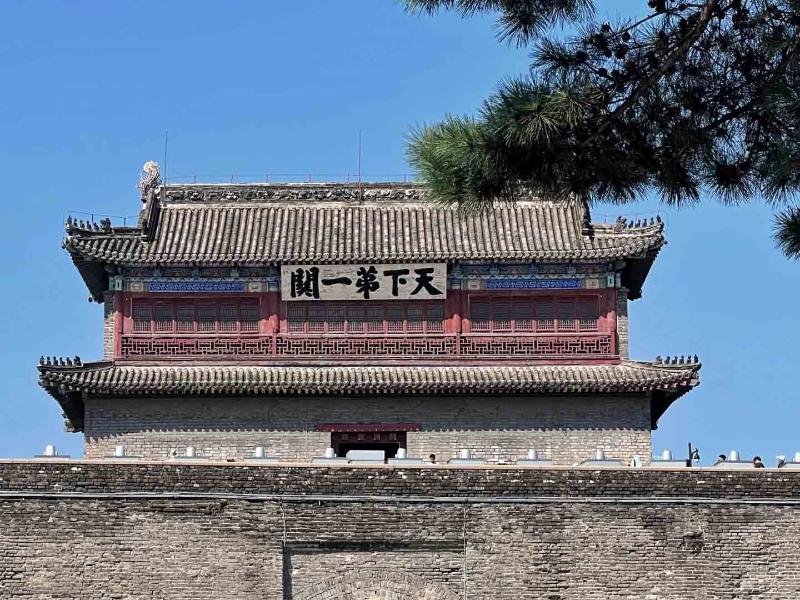
Shanhaiguan is located in Qinhuangdao, Hebei Province. It was built in 1381 (the 14th year of the Ming Hongwu reign) by the general Xu Da under imperial orders. With the Yan Mountains to its north and the Bohai Sea to its south, the pass sits right in the narrow corridor between mountain and sea — the vital gateway connecting North China and the Northeast. Because it "leans on the mountains and embraces the sea," it was named Shanhaiguan (Mountain-Sea Pass). Together with Jiayuguan in the west, it is renowned as the "First Pass Under Heaven" and is also one of the "Three Great Wonders of the Great Wall." The walled city of Shanhaiguan is about 4 kilometers in circumference and includes the "First Pass Under Heaven" arrow tower, the Jingbian Tower, the Wengcheng (barbican), and other well-preserved structures. In 1987, Shanhaiguan was inscribed as part of the Great Wall UNESCO World Heritage Site.
What Visitors Love About It
What impresses visitors most about Shanhaiguan is the magnificent fusion of the grand pass with mountain and sea views. Standing on the First Pass Under Heaven tower, looking north to the Yan Mountains and south to the Bohai Sea, one truly feels the heroic spirit of "one man guarding the pass, ten thousand unable to break through." Many visitors say this is the place where they truly grasp the power of the famous line: "An unparalleled gateway guarding two capitals, the number one pass along the ten-thousand-li Great Wall."
Laolongtou (Old Dragon's Head) is especially spectacular — it's the only part of the Great Wall that extends directly into the sea. The Jiaoshan Great Wall section is also quite distinctive, with some steep and challenging stretches. The ancient city itself has a lively, lived-in atmosphere, and staying overnight to hear the morning roosters crow offers a special charm worth experiencing.
_$1786093299330074115.jpg "h (11)_$1786093299330074115.jpg")
A Story: Xiao Xian Writes the Plaque
On the east gate tower of Shanhaiguan hangs a giant plaque inscribed with the words "First Pass Under Heaven." It measures 5 meters long and 1.5 meters tall, with each character over a meter high. It was written by the Ming Dynasty calligrapher Xiao Xian.
Legend has it that when the garrison commander at Shanhaiguan invited Xiao Xian to inscribe the plaque, Xiao didn't start right away. Instead, he spent days building up his arm strength and practicing his calligraphy. After a long period of preparation, he finally focused his mind and completed the inscription in one smooth, flowing stroke. But here's the interesting part — after finishing, he realized that the character "下" (xia, meaning "under") was missing a dot. The imperial inspector was already on his way, and there was no time to rewrite it. Thinking quickly, Xiao Xian dipped a cloth bundle into thick ink and flung it at the plaque. With a crisp "smack," a perfect dot landed exactly where it needed to be — right under the character "下." It is said that even today, you can still see that the "dot" looks slightly different from the other strokes on the plaque.